Here’s the thing about roof damage: it rarely announces itself clearly. A few missing shingles after a storm, a water stain that showed up on the ceiling overnight, granules collecting in the gutter. Your first thought is usually “how bad is this,” and your second thought is “am I about to get sold a roof I don’t actually need.”
That second worry is fair. Roofing is one of those categories where the answer can genuinely go either way, and a lot depends on what’s happening underneath the shingles, not just what you can see from the driveway.
We’ve walked hundreds of roofs across Northwest Arkansas, through hailstorms and wind events, and plenty of humid summers that test a roof in their own way. This guide walks through what we actually check, what it means when we find it, and how to tell early whether you’re looking at a repair or something bigger.
The First Question: Is the Damage Isolated or Widespread?
Before anything else, we’re figuring out whether the damage is confined to one area or spread across the roof. Isolated damage, like a section of lifted shingles after a windstorm or a flashing seal that’s failed around a chimney, usually gets fixed with a targeted repair. Widespread damage, where the same kind of failure shows up in multiple unrelated spots, tells a different story: the roofing material itself is reaching the end of its usable life.
More often than not, the deciding factor isn’t any single shingle or leak. It’s whether the same failure is repeating in three or four separate areas. One bad patch is a repair. The same problem showing up across the whole roof means the material underneath it all is wearing out together, and patching each spot as it fails becomes an expensive game of catch-up rather than an actual fix.
If you want a quick gut check before calling anyone, walk the perimeter of the house and look at more than one slope of the roof. If the wear looks the same on two or three sides, you’re likely past the point where a single repair solves it.
Shingle Damage: What It’s Actually Telling You
Shingles take the brunt of everything the weather throws at a roof, and they’re usually the first place we look because they tell us the most.
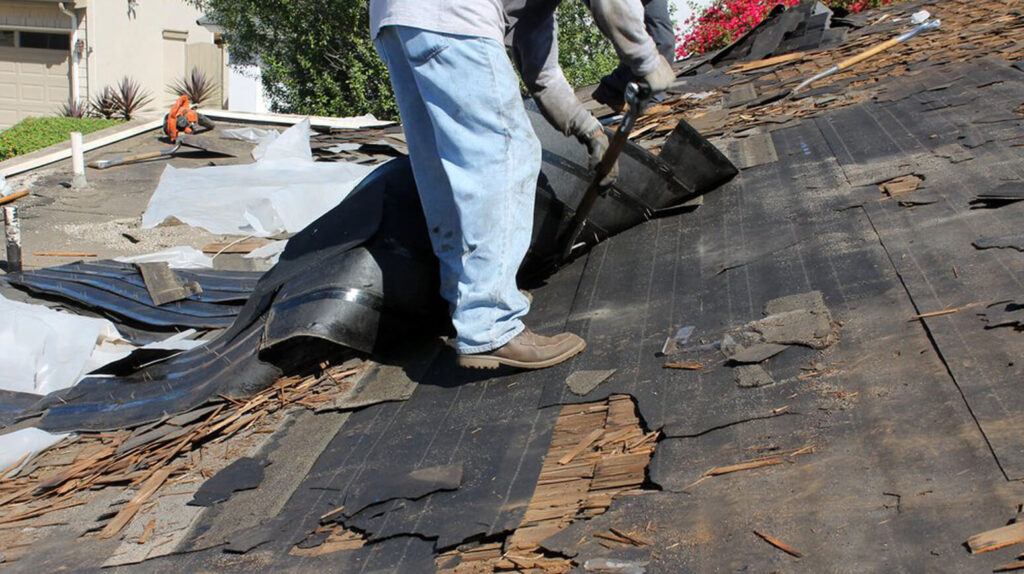
Missing or cracked shingles from a recent storm are, in most cases, a straightforward repair. We replace what’s damaged, match it as closely as we can to the surrounding material, and the roof goes right back to doing its job. Age changes that equation. Most asphalt shingle roofs last somewhere around 20 to 25 years depending on installation quality and how well the roof has been maintained. Once a roof gets into that range, finding a shingle that matches decades-old material gets harder, and it’s not unusual to see the “repair” end up looking patchy even when it’s done well.
Curling or clawing shingle edges are a different signal entirely. That usually means the material itself has aged past the point where it’s flexible enough to lay flat, and it’s often tied to poor attic ventilation trapping heat underneath the roof deck and cooking the shingles from below. A closer inspection usually tells us whether that’s isolated to one slope, which might point to a ventilation issue in that specific section, or spread across the whole roof, which points to the shingles simply running out of life.
Granule loss is the one homeowners notice last, mostly because it shows up in the gutters rather than on the roof itself. A little granule loss every year is normal wear. A noticeable buildup on top of visible curling, especially on a roof under 15 years old, is worth having someone take a look, since the granules are what protect the asphalt underneath from UV breakdown.
In short: isolated, recent shingle damage on a younger roof is a repair. Widespread curling, cracking, or heavy granule loss on an aging roof means the material is wearing out as a whole, and repair stops being a real long-term fix.
Leaks and Flashing: The Most Common Reason We Get Called Out
A leak causes more panic than almost anything else on a roof, and understandably so. Water stains on a ceiling never feel small, even when the actual cause turns out to be minor.
Flashing, the metal strips that seal the roof where it meets chimneys, vents, skylights, and walls, is one of the most common sources of an isolated leak. It’s a small, well-defined point where water can get in, and it’s almost always repairable without touching the rest of the roof. We’ve traced plenty of “the whole roof must be failing” calls back to a single piece of flashing that had corroded or pulled loose over the years.
Widespread or recurring leaks are a different matter. If a leak keeps returning after it’s been patched, or if you’re seeing stains in more than one room, that usually means water has been getting into the roof system for a while, not just recently. At that point we’re less concerned with the shingles on top and more concerned with what’s happening to the decking underneath, since sustained moisture is what actually does the lasting damage.
A single leak traced to one flashing point is a repair. A leak that keeps coming back after being patched, or one that shows up in more than one part of the house, usually means the problem has moved past the surface and into the roof system itself.
What’s Happening Under the Shingles Matters More Than People Think
This is the part of the roof most homeowners never see, and it’s often the deciding factor in the whole conversation.
The decking is the wooden layer underneath the shingles and underlayment, and it’s what everything else is fastened to. If water has been finding its way in for months or years, even slowly, the decking can start to soften or rot. Once that happens, a repair stops being a real option in that area, because there’s nothing solid left to fasten new material to. A soft spot you can feel when walking the roof, or visible sagging when you look down the roofline from the street, is one of the clearest signs we’re dealing with a structural issue rather than a surface one.
This is also where a lot of homeowners are surprised by what we find. A roof can look fine from the ground, shingles intact, no obvious stains, and still have decking that’s been quietly deteriorating from a slow leak that never made it far enough to show up on the ceiling. That’s part of why we always ask to get into the attic during an inspection if it’s accessible. Looking at the underside of the roof deck tells us things the shingles never will.
Solid decking with surface-level shingle damage is repairable. Soft, spongy, or sagging decking usually isn’t, and that’s typically the point where replacement becomes the more honest recommendation.
How Roof Age Changes the Conversation
Age alone doesn’t automatically mean replacement, but it does change how we weigh everything else.
Asphalt shingle roofs typically last 20 to 25 years. Metal roofing tends to last much longer, often 40 to 70 years, though it may need some surface maintenance well before then. A five-year-old roof with storm damage is almost always a repair situation. A 22-year-old roof with the same damage is a different conversation, not because the damage itself is worse, but because the rest of the roof is much closer to the end of its service life, and spending money to repair one section of a roof that’s going to need full replacement in a couple years rarely makes sense.
We’ve seen it go the other way too. A roof that’s poorly installed or ventilated can start showing serious wear well before it hits its expected lifespan, while a roof that’s been properly maintained can sometimes outlast the average. Age is one factor among several, not the whole answer by itself.
Storm and Hail Damage: Why It’s Not Always What It Looks Like
Storms bring their own version of this decision, and Northwest Arkansas gets its fair share of hail and high wind events that put roofs to the test.
Hail damage can be deceptive. Small dents or bruises in the shingles don’t always look dramatic, but they can crack the mat underneath the surface granules in a way that shortens the shingle’s remaining life significantly, even if the roof isn’t actively leaking yet. That’s why we look closely at granule displacement and soft spots after a hailstorm rather than just checking for obvious holes.
Wind damage tends to be more visible: lifted or missing shingles concentrated on one side of the roof, usually the side that faced the storm. If that’s the extent of it and the rest of the roof is sound, a repair handles it. If the storm hit an older roof that was already close to the end of its life, the same damage can be the tipping point that makes replacement the more practical choice.
What Insurance Actually Covers
This is a question that comes up on almost every storm-related call, and the honest answer is that it depends on your policy and the cause of the damage.
Most homeowners insurance policies cover roof damage from sudden, specific events like hail, wind, or a fallen tree limb. What they generally don’t cover is gradual deterioration from age or normal wear, since that falls under maintenance rather than storm damage. This is part of why documentation matters so much. If a storm has come through and you suspect damage, having a roofer inspect and document it before an adjuster visits gives you an accurate, professional record of what actually happened, rather than relying on the adjuster’s walkthrough alone.
We’ve seen claims go smoothly when the damage is clearly storm-related and well documented, and we’ve seen homeowners get partial denials when an older, already-failing roof gets lumped in with genuine storm damage during the same inspection. If you’re filing a claim, it’s worth having a roofer walk the roof with you, or ahead of the adjuster, so the storm damage and the pre-existing wear don’t get confused with each other.
Commercial and Flat Roofs: A Different Set of Signals
Residential shingle roofs aren’t the only ones we get called out for, and flat or low-slope commercial roofs fail in some different ways worth knowing about.
Ponding water, water that sits on a flat roof for more than 48 hours after rain instead of draining, is one of the clearest warning signs on a commercial roof. Occasional ponding after heavy rain isn’t unusual, but ponding that happens consistently points to a drainage problem that will eventually degrade the membrane underneath. Seam separation is another common issue on membrane roofing (TPO, PVC, or EPDM), and when it’s caught early, it’s a repair. Left alone, moisture works its way underneath the membrane and the insulation below it gets wet, at which point a section repair often isn’t enough.
The good news is that flat and commercial roofs are usually easier to inspect regularly than steep residential roofs, which means small problems tend to get caught before they become expensive ones, as long as someone’s actually looking.
What Roof Repair and Replacement Actually Cost
These numbers shift based on roof size, material, and the extent of the damage, but here’s a general range based on what we typically see. Minor shingle or flashing repairs usually run a few hundred dollars up to around fifteen hundred, depending on accessibility and how much material needs replacing. More involved repairs, especially ones involving decking, can run higher. A full roof replacement typically runs well into five figures for an average home, with the total depending heavily on square footage and roofing material, plus how much of the decking needs replacing along the way.
A rule that holds up well across most situations: if a repair quote starts approaching half the cost of a full replacement, replacement is usually the better long-term value, especially on a roof that’s already past the midpoint of its expected lifespan.
What to Expect During a Professional Inspection
A real inspection goes beyond a glance from the ground. We’re checking the shingle surface for wear and displacement, looking at flashing around every roof penetration, checking gutters and drainage for signs of backup, getting into the attic when possible to look at the underside of the decking, and checking for soft spots or sagging along the roofline.
Believe it or not, the attic check is often where we learn the most. Surface appearances can be misleading in both directions. A roof that looks rough from the street can turn out to be structurally sound underneath, and a roof that looks fine can be hiding decking damage that’s been building for years.
A Quick Way to Check Where You Stand
Before you call anyone, it can help to walk through a few questions honestly. Is your roof past the 20-year mark? Has it been repaired more than once or twice in the last several years? Is the damage showing up in more than one area, rather than just one? Are you seeing any soft spots or sagging when you look at the roofline? Did a recent storm hit an already older roof?
If you’re answering yes to two or more of those, replacement is worth seriously considering rather than another round of patching. If you’re mostly answering no, and the damage is limited to one clear area, a repair is very likely the right call.
When to Call a Professional
Call sooner rather than later if you’re seeing water stains on your ceiling or walls, missing or damaged shingles across more than one area of the roof, granule buildup in the gutters that seems heavier than usual, any sagging along the roofline, or a roof that’s recently been through a hailstorm or major wind event, even if you don’t see obvious damage from the ground.
Active leaks and any visible sagging aren’t wait-and-see situations. Everything else usually has some room to get a proper assessment scheduled without the problem getting meaningfully worse in the meantime.
Maintenance That Actually Extends a Roof’s Life
Keeping gutters clear so water drains the way it’s supposed to instead of backing up under the shingle edge makes a real difference over time. The same goes for having attic ventilation checked, since poor ventilation is one of the most common reasons shingles age faster than they should. Addressing small issues, a lifted shingle, a loose piece of flashing, as soon as they’re noticed keeps them from turning into decking problems down the line. And after any major storm, it’s worth having the roof looked at even if nothing looks obviously wrong, since some of the most damaging issues aren’t visible from the ground.
If there’s one thing years of doing this has taught us, it’s that the roofs that last the longest aren’t necessarily the ones with the best materials. They’re the ones where small problems got handled early instead of waiting.
Frequently Asked Questions
How do I know if roof damage is a repair or a replacement?
Check whether the damage is confined to one area or repeating across multiple sections of the roof. Isolated damage on an otherwise sound roof is usually a repair. Damage showing up in several unrelated spots, or on a roof already near the end of its expected lifespan, points toward replacement.
How long does an asphalt shingle roof actually last?
Most asphalt shingle roofs last 20 to 25 years depending on installation quality and how well it’s been maintained. Metal roofs typically last 40 to 70 years.
Is a roof leak always a sign I need a new roof?
No. Many leaks come from a specific, localized issue like failed flashing around a chimney or vent, which is repairable without replacing the roof. Leaks that keep recurring or show up in multiple rooms usually indicate a bigger, more widespread problem.
Does hail damage always mean I need a new roof?
Not necessarily, but hail damage can be more serious than it looks. Even small dents can crack the shingle mat beneath the surface and shorten the roof’s remaining life, so it’s worth having a professional check for granule displacement and soft spots after a storm.
Will homeowners insurance cover my roof repair or replacement?
Usually, if the damage came from a sudden event like hail, wind, or a fallen tree limb. Gradual wear from age typically isn’t covered. Having a roofer document the damage before the adjuster visits helps keep the claim accurate.
What does it mean if my roof deck is soft?
Soft or spongy spots on the roof usually mean water has been getting into the decking for an extended period, which weakens the wood underneath the shingles. This typically requires replacing that section of decking, and depending on how widespread it is, may point toward full replacement.
Is it cheaper to keep repairing an old roof or replace it?
If repair costs start approaching half the price of full replacement, or if the roof has already needed several repairs in recent years, replacement is usually the better long-term value.
Do flat or commercial roofs fail the same way as residential roofs?
Not exactly. Flat and low-slope roofs are more prone to ponding water and seam separation than shingle failure, and catching those issues early usually keeps them a repair rather than a full replacement.
Should I get a second opinion before agreeing to a full roof replacement?
Yes. A full replacement is a significant investment, and it’s reasonable to get a second, independent inspection before committing, especially if the first recommendation surprised you.
How often should I have my roof inspected?
An annual inspection is a good baseline, with an additional check after any major hail or wind event, even if there’s no obvious damage from the ground.
The Bottom Line
Every roof tells its own story, and the honest answer to repair or replace almost always comes down to what’s happening beneath the surface, not just what’s visible from the yard. Most of the time, damage that feels alarming turns out to be a manageable, targeted fix once someone’s actually up there looking at it.
A proper inspection is what separates a real answer from a guess. If you’re dealing with damage, a recent storm, or just aren’t sure what you’re looking at, TCG Roofing is happy to take a look and give you a straight answer, whether that means a simple repair or something more. Reach out to schedule an inspection, and we’ll walk the roof with you and lay out exactly what we’re seeing before you have to make any decisions.